May 22, 2017
Today the Supreme Court of the United States released its opinion in Cooper v. Harris, holding that North Carolina’s redrawing of Congressional Districts 1 and 12 violated the 14th Amendment’s Equal Protection Clause. Justice Kagan delivered the opinion of the Court, with Thomas, Ginsburg, Breyer, and Sotomayor joining. Thomas also filed a concurring opinion. Alito, joined by Roberts and Kennedy, dissented.
Procedural Posture: A three-judge federal district court held both districts unconstitutional. It found that racial considerations predominated in the drawing of District 1’s lines and rejected the State’s claim that this action was justified by the VRA. As for District 12, the court again found that race predominated, and it explained that the State made no attempt to justify its attention to race in designing that district.
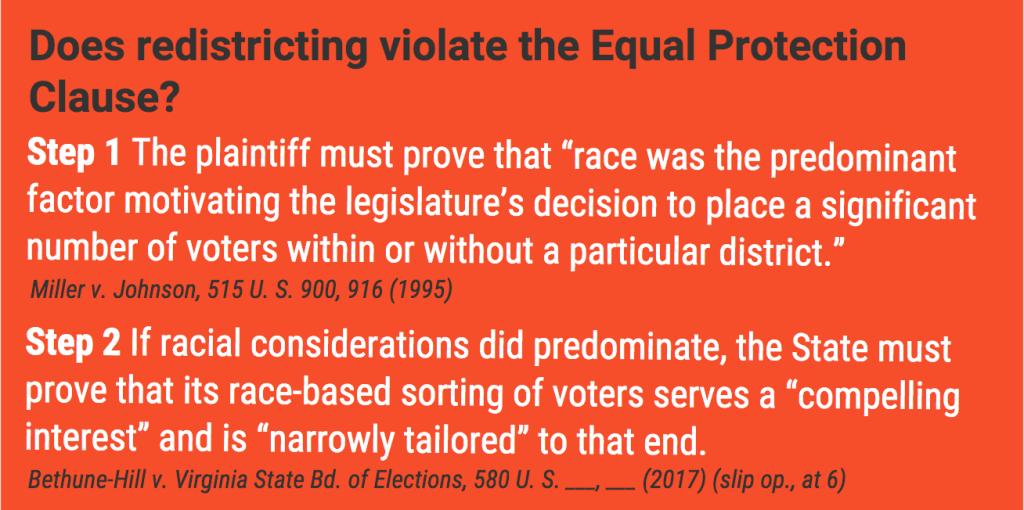
Applicable Law: The Equal Protection Clause prohibits a State, without sufficient justification, from “separat[ing] its citizens into different voting districts on the basis of race.” Miller v. Johnson, 515 U. S. 900, 911 (1995). When a voter sues state officials for drawing such race-based lines, judges apply a two-step analysis to determine if the drawing of the voting district violates the U.S. Constitution:
THE REDRAWING OF DISTRICT 1
SCOTUS found no clear error in the District Court’s finding of race as the predominant factor in the redistricting of District 1. The State admitted it’s motivation of drawing District 1 as a “majority-minority” district (at least 51% African American voting age population).
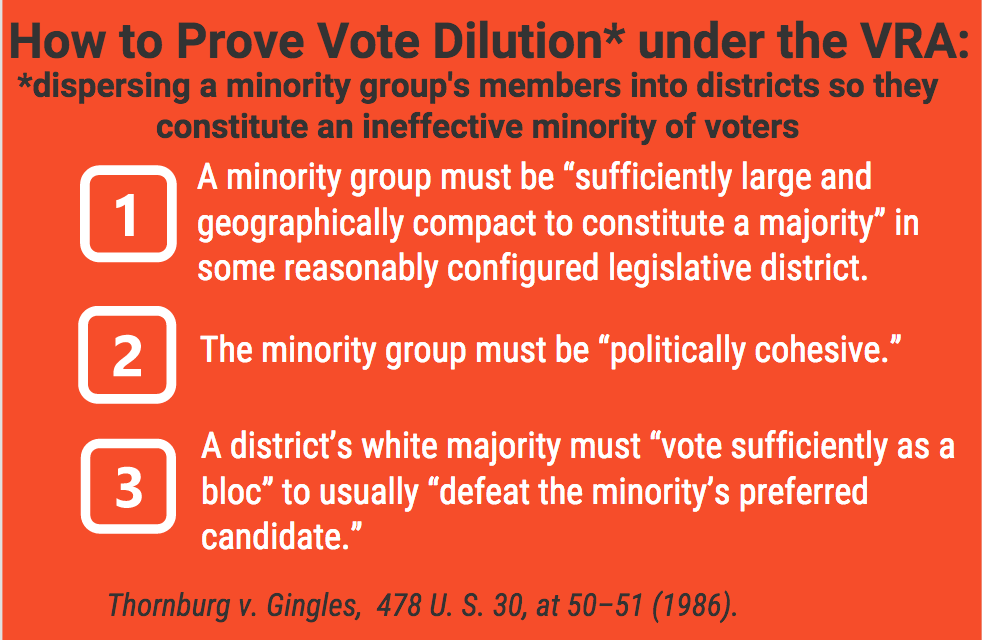
As to whether the sorting of voters served a compelling interest that was narrowly tailored, the State argued that by drawing District 1 as a “majority-minority” district it was seeking to comply with the Voting Rights Act, which has long been viewed as a compelling interest under constitutional law. SCOTUS and the District Court disagreed, holding that the State did not show that it was necessary under the VRA to make District 1, a district that was already considered a safe district for African-American preferred candidates, a “majority-minority” district. African-American preferred candidates had enjoyed large cross-over support for the last twenty years in the district, and the fact that population increases required the State to redistrict didn’t mean race-based requirements were necessary to comply with the VRA’s prohibition against vote dilution.
THE REDRAWING OF DISTRICT 12
The State denied that race was a factor in District 12’s redesign, alleging that the motivation was purely political — to pack the district with Democrats, which is perfectly legal. In finding no error with the District Court’s required “sensitive inquiry” into all “circumstantial and direct evidence of intent,” SCOTUS upheld the finding of racial predominance. In coming to its conclusion, SCOTUS noted that population changes did not require resizing the district and that redrawing made drastic changes in the district’s racial composition. SCOTUS also pointed to public statements made by legislators showing their motivation for redrawing the district — that is, to create a “majority-minority” district, purportedly to comply with the VRA.
As the State did not make an attempt to justify race-based districting in District 12 in its pleadings, SCOTUS upheld the District Court’s judgment, that racial considerations unconstitutionally predominated the redrawing of District 12.
 Natalie K. Mitchell, J.D.
Leave a comment